Combined Colour Light Distant and Semaphore Stop Signals
(Page 1 of 1)
Different methods have been implemented to present drivers with a smooth transition from semaphore signal territory into colour light signal territory. No special arrangements are needed where the transition from one form of signal to the other is separated by around a mile or more, providing a clear gap between them. If, however, the colour light territory closely follows the semaphore territory, then the question arises as to what form the last signal at the exit from the semaphore territory should take to enable it to display the necessary 'caution' aspects on approach to the first colour light signal in the sequence.
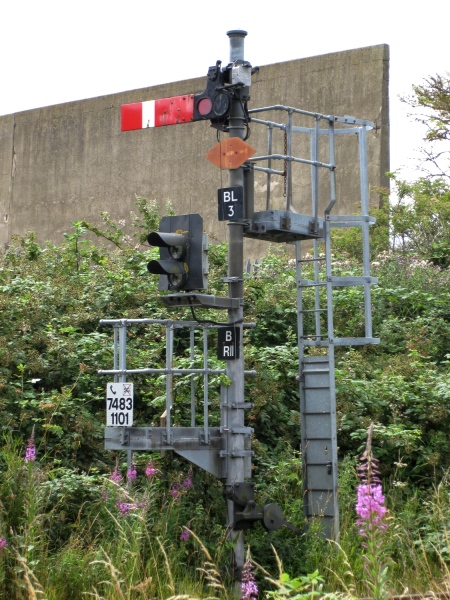
One option is to install a motor-operated semaphore distant arm below the last semaphore stop signal. Another option is to replace the last semaphore stop signal with a colour light stop signal equipped to display the appropriate 'caution' aspects relating to the colour light signals beyond. One of the original methods commonly employed entailed the provision of a hybrid form of signal comprising a colour light distant signal mounted underneath a semaphore stop arm. The information on this page principally relates to the Southern Railway's practice concerning these signals. The semaphore signals involved may be of the lower quadrant or upper quadrant variety.
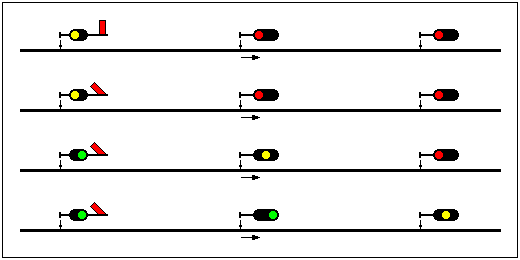
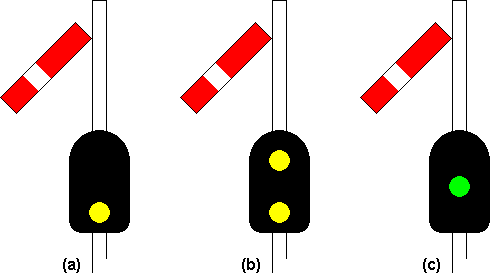
Where provided, a colour light distant signal was mounted underneath the last semaphore signal at the exit from the semaphore signal territory, and it gave drivers an advance indication of the aspect displayed by the first colour light stop signal in the sequence ahead. The earliest of these colour light distant signals mounted below semaphore stop arms could display only single yellow ('caution') or green ('clear') aspects.
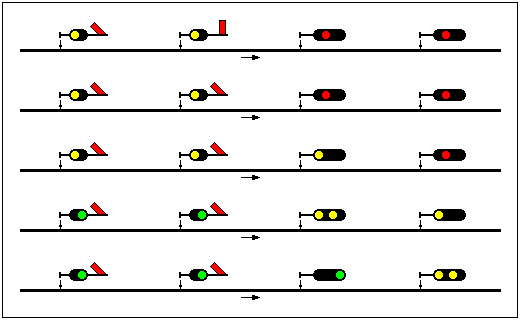
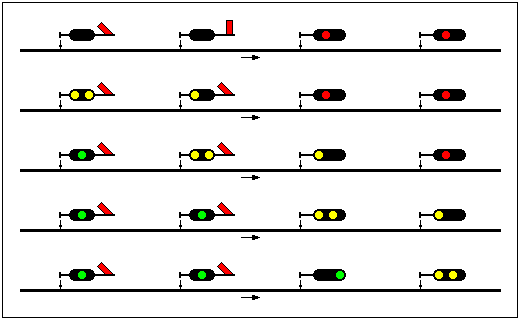
Where the distance from the last semaphore signal to the first colour light stop signal would provide drivers with insufficient braking distance, a second colour light distant signal was mounted below the semaphore stop signal preceding the last semaphore stop signal. Originally, both the inner and outer distant signals were arranged to show the same aspect at the same time (single yellow or green) rather than allowing a double yellow aspect to be displayed at the outer distant signal, which could be misleading to drivers if the semaphore signal beyond was at 'danger'.
|
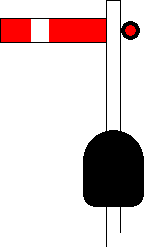
The first colour light distant signals mounted below semaphore stop arms were brought into use at Elephant & Castle on the Southern Railway, in March 1926. It was quickly realised that the colour light distant signal aspects overpowered the weaker lights of the semaphore arms above, increasing the risk of the signal being inadvertently passed at 'danger'. After just a few days in service, the colour light distant signals were altered to display no aspect while the semaphore arm was in the 'danger' position.
|
|
|
Fig. 4: Colour Light Distant Signal unlit while semaphore stop arm at 'danger'.
|
|
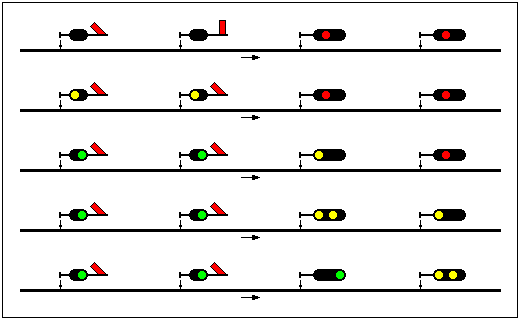
From 1929, the practice was introduced of maintaining an outer colour light distant signal unlit while the semaphore stop arm above the corresponding inner colour light distant signal was at 'danger', even though the semaphore arm above the outer distant signal may be in the 'off' position. The outer distant signal was therefore only illuminated when both semaphore arms were 'off' and the line was clear at least as far as the first colour light stop signal.
|
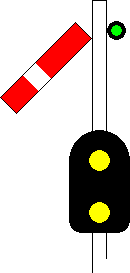
Colour light distant signals mounted below a semaphore stop arm and capable of showing a double yellow aspect first appeared in 1929, enabling the display of a normal colour light aspect sequence leading into four-aspect signalling territory. During 1929, several existing two-lens colour light distant signals mounted below semaphore stop arms were replaced with three-lens heads equipped with two yellow lights.
|
|
|
Fig. 6: Colour Light Distant Signal displaying Double Yellow Aspect.
|
|
The provision of three-lens colour light distant signals below semaphore stop arms enabled inner and outer distant signals to display different aspects at the same time. Given that the outer distant signal was only allowed to illuminate when the semaphore arms above it and the inner distant signal were both 'off', it could never show a double yellow aspect when the semaphore arm above it was 'off' but the one beyond was at 'danger'.
From 1939, it became practice that no light was exhibited alongside a semaphore stop arm in the 'clear' position if a colour light distant signal was provided below it. This was achieved by replacing the green spectacle in the semaphore arm with a blinder, leaving just the red spectacle in place.
With no green light being shown alongside the semaphore stop arm in the 'clear' position, the colour light distant signal provided the only visible 'proceed' aspect to drivers during darkness. It was therefore essential that the colour light distant signal always displayed an aspect when the semaphore stop arm above was 'off'. The former practice of extinguishing the outer distant signal when the semaphore arm above it was 'off' but the one beyond was at 'danger' was accordingly discontinued, and the outer distant signal was altered to display a single yellow aspect in this circumstance. This last step in the evolution of combined colour light distant and semaphore stop signals on the Southern Railway brought them into conformity with similar signals introduced by the LMS in March 1929 on approach to the Manchester Victoria - Manchester Exchange colour light signalling area.
The practice of mounting a colour light distant signal below a semaphore stop arm remained as a permitted option within the signalling standards until 1995. The last surviving example of this hybrid combination, at Belasis Lane (Billingham), was abolished early in 2021.